Make Standard Bottles Unmistakably Yours - Without a Big MOQ

Updated: Sep 21
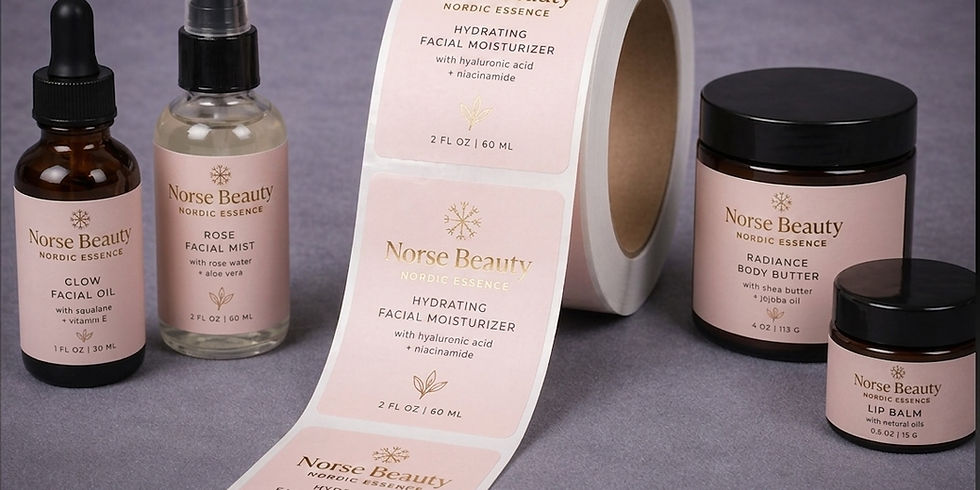
One of the biggest frustrations for small cosmetic brands is the minimum order quantity barrier. Custom bottle colors look incredible — but the factories that produce them typically require 5,000 to 25,000 units before they'll run your shade. For a startup testing the market with a new serum or shampoo, that's an impossible ask. See how we can help.
The good news? A well-designed label on a quality stock bottle can look just as premium, and in some cases, even more distinctive, than a tinted container. Countless global brands, from apothecary-style skincare lines to minimalist perfume houses, have built entire visual identities around a simple white or transparent bottle and a beautifully executed label.
This guide breaks down how to do it right: what label types to choose, what the law requires on your packaging, where the DIY limit is, and when it's time to call in a professional.

Why Labels Are the Smart Choice for Startups
When you're ordering in small volumes, say, 50 to 500 units, your supplier normally only can provide you with plain stock bottles. These are typically available in white HDPE or PP, black PET or PP, or transparent PET, and glass. They're functional, well-made, and take labels beautifully.
Custom moulded bottles in a specific colour or shape require tooling costs (often €3,000–15,000 for a new mould) plus a production run large enough to make the per-unit price viable. That's a minimum order of thousands of units, all tied up in capital before you've sold a single bottle.
Labels flip this equation entirely. A short digital print run of 100–500 labels can cost as little as €0.10–0.80 per label, making premium packaging genuinely accessible to startups. You can also update your label for a seasonal edition or formula change without scrapping your existing bottle stock.

Label Types and What They do to a Bottle
The material and finish of your label changes everything about how a bottle feels in the hand and reads on a shelf. Here are the most common options and what each one is best suited for.

The DIY Label Limit: Where Home Printing Stops Working
Many founders start by printing labels at home or at a local copy shop using Avery sheets and an inkjet printer. For product photography, samples, and market testing, this is completely reasonable. But there is a clear point at which DIY label printing creates more problems than it solves.
1–50 units — Samples & testing Home inkjet printing on Avery sheets, cut by hand or craft cutter. Remember - Not water-resistant without laminate.
50–300 units — Soft launch Online label printers (StickerMule, Noissue, Etikettenshop) offer runs from 50–100 units. Fully waterproof, professionally finished. Around €0.50–1.20 per label. We can design and print your labels, you can add them by hand to your products.
300–2,000 units — Market rollout The cost per label drops significantly at this volume. Choose a more professional label printer who can provide physical proofs. Discuss adhesive type for your specific bottle material. Norse Packaging can help you when you are at this stage and groving you business.
2,000+ units — Growth phase Flexographic printing becomes cost-competitive above roughly 2,000 units and gives superior colour consistency across a run. This is where your sourcing agent adds the most value.
The hard limits of DIY printing are water resistance (inkjet inks wash off in a shower environment), adhesive quality (home label sheets are not formulated for curved surfaces or cold and wet conditions), colour accuracy (your screen and home printer will not match), and most importantly - legal compliance, which requires legible, durable text that won't fade or peel.
Important: If your product will be used in a wet environment, like shower gel, shampoo, body lotion, home-printed labels are never suitable for sale. The label must remain legible and intact for the entire expected life of the product. This is a legal requirement, not just an aesthetic one.
Legal Obligations: What Must Appear on a Cosmetic Label
This is where many small brands make costly mistakes. In the EU, cosmetic labelling is governed by Regulation (EC) No. 1223/2009. In the UK, the equivalent is the UK Cosmetic Products Enforcement Regulations 2013. Similar frameworks exist in the US (FDA), Canada, and Australia. Non-compliance risks product recalls, fines, and damaged trust.
Here is what must appear on the label of every cosmetic product sold to consumers in the EU and UK:

1. Name and address of the responsible person The EU and UK require a named responsible person — a company or individual legally based in the EU or UK who takes responsibility for the product's compliance. This address must appear on the label.
2. Country of origin (for products manufactured outside the EU/UK) If your product is made in South Korea, China, or anywhere outside the bloc, the country of origin must be stated.
3. Nominal content (weight or volume) Stated in metric units. Must match the actual fill volume or weight within permitted tolerances. For example: "100 ml" or "50 g".
4. Date of minimum durability or PAO Products stable for 30 months or less need a "best before" date (the hourglass symbol). Products lasting longer than 30 months need a Period After Opening (PAO) symbol - the open jar icon - with the number of months after opening the product remains safe, for example "12M".
5. Precautions for use Any warnings required by the regulation - for example, "keep out of reach of children", "avoid contact with eyes", or specific warnings for products containing hydrogen peroxide, retinoids, or certain preservatives.
6. Batch number or lot code Required for traceability. This allows recall of a specific production batch if a problem is identified. Can be printed directly on the label or stamped onto the bottle base.
7. Function of the product The purpose must be clear, unless it is obvious from the product's presentation. "Facial moisturiser", "hair conditioner", "body wash" stated plainly.
8. List of ingredients (INCI names) All ingredients must be listed in descending order of concentration using their International Nomenclature Cosmetic Ingredient (INCI) names. Ingredients present at or below 1% may be listed in any order after those above 1%. Colourants may be listed in any order at the end, using Colour Index (CI) numbers.
On font size: EU regulation requires that label text is "indelible, easily legible, and clearly visible." Industry practice sets a practical minimum of 6pt for body text and 7pt for INCI lists on standard-sized packaging. On very small packaging (under 10 ml), the ingredients list may be placed on a leaflet or tag attached to the product, with an abbreviated reference on the label itself.
What can appear on a leaflet instead of the label:
Full ingredient list (with symbol reference on label)
Extended precautions for use
Detailed instructions for professional products
What must always be on the label itself:
Name and address of responsible person
Content weight / volume
Date of durability / PAO symbol
Batch number
Label Material and Adhesive: Choosing What Survives the Bathroom
Even the most beautiful label fails if it peels, wrinkles, or fades. The environment a cosmetic product lives in is harsh, steam, water, oils, and repeated handling. Label material and adhesive selection must match the product's use context.

For adhesive, specify a permanent, water-resistant acrylic adhesive for any leave-on or rinse-off product. If your product will be chilled (eye creams stored in the fridge, for example), specify a cold-temperature adhesive as standard adhesives can fail below 5°C. Ask your label printer for a sample to test on your specific bottle before committing to a full run.

When to Stop Doing It Yourself and Call a Sourcing Agent
The DIY approach is valuable for testing and learning. But there are clear signals that it's time to professionalise your packaging process.
You're ordering 300+ units at a timeAt this volume, a professional digital print run is cheaper per unit than home printing, and the quality difference is dramatic. A sourcing agent can bundle label orders with bottle procurement for cost savings.
You're approaching retail Buyers from pharmacies, boutiques, and online marketplaces will scrutinise your packaging. Retail-grade label quality and full regulatory compliance are non-negotiable at this stage.
You're selling in multiple markets EU, UK, US, and Australian regulations differ. Managing multiple label versions with different required information becomes complex quickly. This is exactly what a sourcing agent handles.
Your formula has changed A formula change means a new INCI list, potentially new stability data, and updated labelling. Reprinting outdated labels is a compliance risk. Centralising this with a professional partner reduces errors.
Key Takeaways for Small Cosmetic Brands
You don't need to wait for a large budget to have packaging that represents your brand properly. A well-chosen stock bottle and a professionally printed, legally compliant label can compete with any custom packaging on a retail shelf.
The path from DIY to professional is gradual and each step should be driven by your production volume, your route to market, and the markets you're selling in. Start smart, test early, and build quality into your process before you scale.

Ready to level up your packaging? Our team sources compliant, retail-ready stock bottles and short-run labels for cosmetic startups across Europe. We can also provide the outerboxes in small moq. Get in touch to discuss your next launch. Check out our products and see if you find something you like.
© Norse Packaging - info@norsepackaging.com
This blog is for informational purposes only and is not legal advice, so please consult a qualified professional about your specific situation


Comments